Uncontrolled voltages are key suspects in Spanish outage investigation
Spain’s energy minister Sara Aagesen has revealed that failure to control voltages could have played a critical role in the catastrophic outage of 28th April.
Speaking for the first time about the known causes of Europe’s biggest shut-down, she told Reuters on 14th May that the event was triggered by a substation breakdown in Granada, followed by failures seconds later in Badajoz and Seville.
But what caused the substations to fail, and how the initial problem resulted in a cascade of grid disconnections affecting the whole Iberian Peninsula and parts of France, is still the subject of multiple investigations involving ‘millions of pieces of data’.
The government’s investigation is looking at reports by operators of volatility in the days before the blackout and is examining excessive voltage as one possible cause for the loss of generation, according to Aagesen.
Renewables to blame?
However, a spokesperson for grid operator REE said Spain’s main transmission grid had no incidents on April 28th before the blackout, and the power loss occurred due to causes outside the grid, possibly at generation plants themselves or in smaller grids not managed by REE.
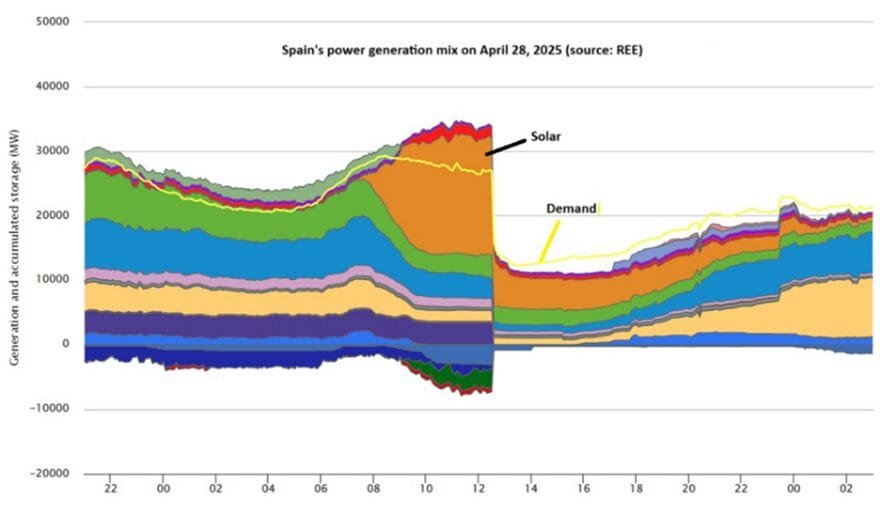
Some commentators have speculated that over-reliance on renewables is one of the root causes, with solar responsible for 70% of Spanish generation at the time of the disaster. The government denies this.
It may be months before a comprehensive picture emerges of why this happened. Major outages on a similar scale have occurred worldwide, long before the transition to renewables.
But Spain’s experience may prove a reminder that building an increasingly complex low-carbon electricity system demands fresh approaches to grid management.
Connecting thousands of dynamic energy resources (DERs) to a grid designed decades ago requires a whole system strategy to ensure its resilience – not least, by implementing total voltage control solutions across the board.