Partial Discharge Detection to Data-Driven Insight in High Voltage Asset Management
-
16 March 2026
-
Thomas Whyte
Partial discharge detection plays a critical role in identifying insulation defects in high-voltage (HV) electrical assets. However, as electrical networks evolve and asset criticality increases, simply detecting partial discharge (PD) activity is no longer sufficient.
Today, utilities and network operators are shifting toward data-driven asset management, where partial discharge monitoring is used not only to detect faults but to generate actionable insights, predict failures, and optimise maintenance strategies.
This transition, from detection to insight, is transforming how organisations manage risk, improve reliability, and extend asset life.
What Is Partial Discharge and Why It Matters
Partial discharge refers to localised electrical discharges within insulation systems that do not completely bridge the electrodes. While often invisible, PD activity is a key early indicator of insulation deterioration in high-voltage assets such as switchgear, transformers, and cables.
If left unmanaged, partial discharge can lead to:
- Progressive insulation failure
- Unplanned outages
- Increased maintenance costs
- Reduced asset lifespan
This makes partial discharge detection a fundamental component of modern condition assessment of electrical assets.
The Evolution of Partial Discharge Detection
Early partial discharge detection methods focused on simple amplitude-based measurements, providing only a basic indication of whether PD activity was present.
As instrumentation evolved, additional diagnostic parameters were introduced, including:
- Pulse repetition rate
- Phase-resolved PD patterns
- Waveform analysis
These advancements significantly improved diagnostic confidence, enabling engineers to detect lower-level discharge activity and better differentiate between true PD and electrical noise.
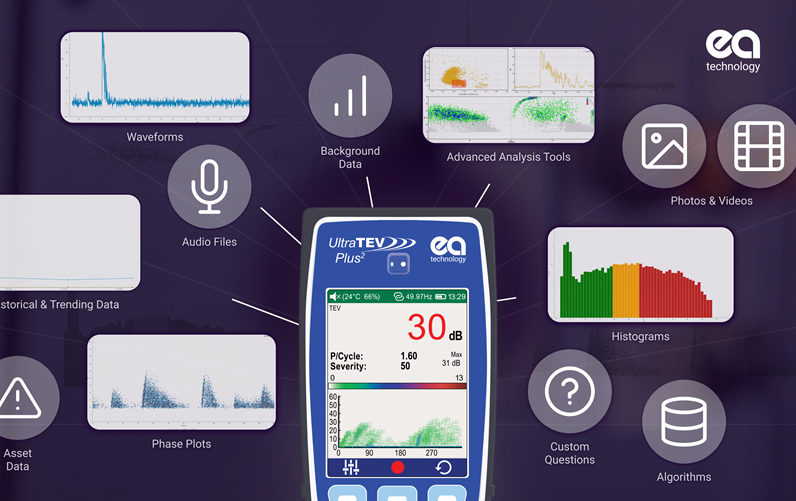
Modern handheld PD instruments, such as UltraTEV Plus², now combine these capabilities into a single platform, enabling far richer and more reliable data capture during routine testing.
The Shift Towards Data-Driven Asset Management
At the same time, the operating environment for electrical networks has changed significantly. Increased asset criticality, reduced redundancy, and higher outage costs mean that every inspection must deliver more than a simple snapshot.
Modern partial discharge monitoring is now expected to:
- Generate complete and high-quality datasets
- Support long-term trending and analysis
- Enable informed, data-driven decisions
This aligns closely with broader asset management and risk optimisation strategies used by network operators.
How Data Enhances Partial Discharge Monitoring
Advances in testing capability and data recording have transformed how PD surveys are conducted.
Field technicians can now focus on:
- Efficient, repeatable data capture
- Standardised testing procedures
- Recording complete datasets during each visit
Meanwhile, detailed analysis and decision-making are increasingly performed off-site using centralised platforms.
This approach allows partial discharge detection to evolve from a detection-led activity into an insight-led process, supporting broader asset management objectives and improving decision accuracy.
The Value of Rich Partial Discharge Data
A single PD magnitude reading can confirm the presence of discharge activity—but provides limited insight into:
- Defect type
- Severity
- Progression over time
In contrast, combining multiple data types—such as:
- Phase-resolved patterns
- Waveform characteristics
- Pulse repetition rates
provides a far more accurate understanding of asset condition.
Why Complete Datasets Matter
When full datasets are captured:
- Results can be revisited as analytical techniques improve
- Historical data gains long-term value
- Asset behaviour can be tracked more accurately over time
The Importance of Context in PD Data
Contextual information significantly enhances the value of partial discharge monitoring data.
Key contextual inputs include:
- Precise measurement locations
- Asset configuration details
- Environmental conditions
- Supporting notes and images
When stored in a centralised system, this information enables:
- More accurate interpretation
- Better comparison across surveys
- Stronger decision-making confidence
Consistency and Repeatability in PD Surveys
For partial discharge detection to support long-term asset management, data must be consistent and comparable over time.
Without consistency:
- Variations in results may reflect testing differences rather than asset condition
- Trend analysis becomes unreliable
Best Practice for Reliable PD Surveys
- Use repeatable survey structures
- Measure at consistent locations
- Apply standardised testing methods
Guided workflows and centralised data platforms reduce dependence on individual technicians and ensure that data is collected in a consistent, repeatable manner.
Advanced Analysis: Unlocking Insights from Large PD Datasets
As PD surveys generate larger and more structured datasets, the focus shifts from analysing individual measurements to extracting insight at scale.
Large, high-quality datasets enable:
- Identification of patterns across multiple assets
- Improved classification of PD behaviour
- Earlier detection of emerging issues
Advanced analytical algorithms can now automatically recognise characteristic discharge patterns, improving both the speed and reliability of analysis.
As these datasets grow, analytical models continue to improve—delivering increasing value back to network operators through enhanced tools and methodologies.

Real-World Benefits for High Voltage Networks
The transition from partial discharge detection to data-driven insight delivers significant operational benefits:
- Earlier fault detection and reduced risk of failure
- Improved maintenance planning through predictive insights
- Reduced outages and downtime
- Lower operational and excavation costs
- Extended asset lifespan
These benefits make data-driven PD monitoring a critical component of modern high-voltage asset management strategies.
Conclusion: Designing PD Surveys for Insight, Not Just Detection
Partial discharge testing is no longer defined by what can be identified during a single inspection. Its true value lies in the completeness, consistency, and context of the data collected—and how that data is used over time.
By combining:
- Structured data capture in the field
- Advanced analytics and off-site interpretation
- Centralised data management platforms
Organisations can move beyond reactive maintenance toward proactive, insight-led asset management.
Designing surveys for insight rather than detection ensures:
- Reliable long-term trending
- Greater data ownership and continuity
- More confident, evidence-based decisions
Ultimately, this approach supports safer, more resilient electrical networks built on data—not assumption.
Take the Next Step in Data-Driven Asset Management
To learn how partial discharge detection and monitoring solutions can support your network:
- Explore partial discharge detection solutions
- Learn more about condition assessment services
- Contact our team to discuss your requirements
Learn more about the Managed Surveys platform here: