Case Study: LV Management with SA Power Networks
Client: SA Power Networks
This case study describes how EA Technology investigated a range of strategies for SA Power Networks to respond to future challenges on the low voltage (LV) network.
These challenges included:
Accommodating increasing customer uptake of Distributed Energy Resources (DER) while maintaining quality of supply and minimising network augmentation.
Customers making use of available value streams from their DER investment through participation in VPPs and access to markets for energy, ancillary services and network support.
The approach taken by EA Technology clearly allowed SA Power Networks to understand which of the possible strategies delivered the best value moving forward and presented the least overall cost to both network (augmentation expenditure) and customer (energy curtailed).
Historically, SA Power Networks’ electricity network was designed to meet the needs of customers who only connected to passive and predictable technology. But a significant shift was changing how customers connected to the LV network. Customer uptake of DER was rapidly increasing via solar photovoltaic energy with behind-the-meter storage.
The traditional ‘passive’ approach to LV management would not be fit for purpose for the next regulatory period. After a competitive tender process, SA Power Networks decided to work with EA Technology to develop a strategy for the efficient management of their LV network.
The project investigated a range of strategies which SA Power Networks could employ to respond to future challenges on the LV network. EA Technology identified the following management strategies to cater for the uptake of DER:
Static limits – allocating a static maximum export limit to each new DER owner.
The dynamic template model – understanding where capacity might be exceeded and issuing export limits based on representative network.
The fully dynamic model – understanding where capacity might be exceeded and issuing export limits based on full network model.
Network augmentation – increases the hosting capacity on constrained circuits by upgrading network infrastructure.
After identifying representative LV circuits, EA Technology performed detailed power flow analysis to determine the DER hosting capacity of these circuits. Using the Transform Model, EA Technology’s proprietary techno-economic modelling tool, the financial value of each of these strategies to SA Power Network’s customers was assessed by investigating the cost to implement each strategy against the value created to the general mass of customers by avoiding DER curtailment caused by LV network limitations. Different growth scenarios were created, and net costs and investment regret was assessed to decide upon the final best approach.
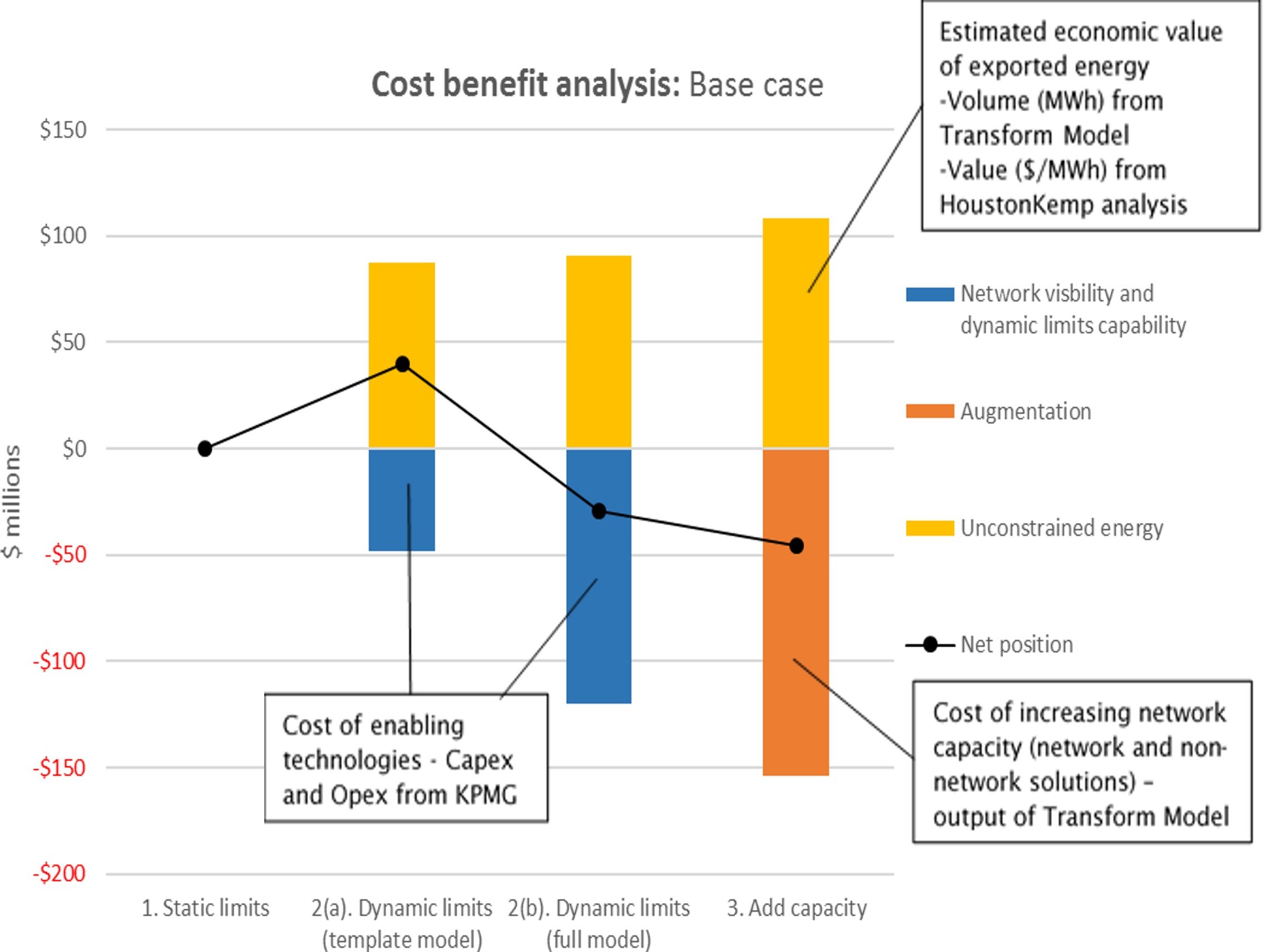
It was found that the Dynamic Templates approach could achieve tens, or in some cases, hundreds of millions in customer savings over 15 years compared to the static limits strategy.
This approach clearly allowed SA Power Networks to understand which of the possible strategies delivered the best value moving forward and represented least overall cost to both the network (augmentation expenditure) and the customer (energy curtailed).
SA Power Networks could then use the modelling outputs to communicate with customers about the options for investment going forward and to get their input and support their business plan.
SA Power Networks were also able to gain full support of their regulator AER and their full funds request granted as AER believed that the modelling work performed by EA Technology provided robust evidence.
An extract from their determination states:
EA Technology have vast experience in LV network solutions. Here are some of our key expertise:
Other relevant projects we have worked on: