Offline Partial Discharge Cable Mapping
Ensure the reliability and safety of your power network with EA Technology’s industry-leading Offline Partial Discharge (PD) Cable Mapping service. Our advanced cable condition assessment identifies insulation failures, detects water treeing, and provides actionable insights to help you avoid costly outages.
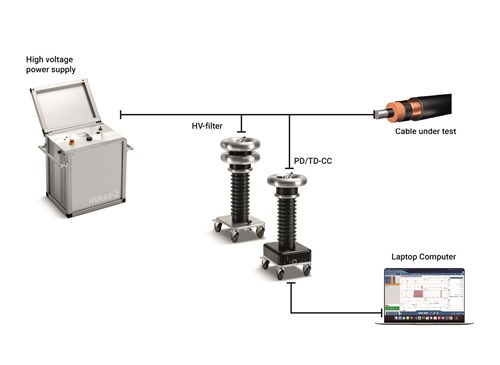
Figure 1: Non- destructive VLF testing.
Offline Partial Discharge Cable Mapping is an offline cable condition assessment method where the cable system is isolated from the electrical network and energised with a discharge-free test supply. This allows the measurement of the magnitude and origin of partial discharge activity within high-voltage cable insulation with minimal background noise.
By capturing multiple partial discharge events, a graphical representation (“partial discharge map”) is created along the cable length, helping asset managers visualise weak spots and potential risks.
How Does Partial Discharge Mapping Work?
To measure partial discharge activity, the cable must be energised at a voltage level of at least the normal working voltage (U0). Supplying this test voltage for long cables is challenging due to the high-power requirements. To overcome this, a Very Low Frequency (VLF) high-voltage test supply is used.
This enables long lengths of cable to be energised at the required test voltage from a standard 230V 13A outlet. The frequency of the test voltage is dependent on the cable length but is typically 0.1Hz.
Each PD event is detected via a high voltage coupling filter, captured by a digital oscilloscope, and analysed with specialist software. The final output is a partial discharge map highlighting insulation deterioration and potential failure points.
To find out more, contact us:
+65 6443 3833
Related Services
Online Cable Condition Assessment (CDC)
Online partial discharge (PD) testing enables the collection of PD information from MV/HV cables with the cables still online. Fin...
LIRA Cable Condition Analysis Service
Non-Destructive Testing of cables that do not require cables to be energised to high voltages. Safer than alternative methods in ‘...